Research Projects

Euclid high-z quasars

Finding quasars beyond z = 7 opens a window onto the earliest supermassive black holes, but previous surveys could reach only the brightest objects. Our Euclid search discovered 31 quasars at z = 6.6–7.8, including 12 beyond z = 7, more than doubling the known sample at these redshifts. This population lets us study how early black holes grew and use their light to probe intergalactic gas during reionization.
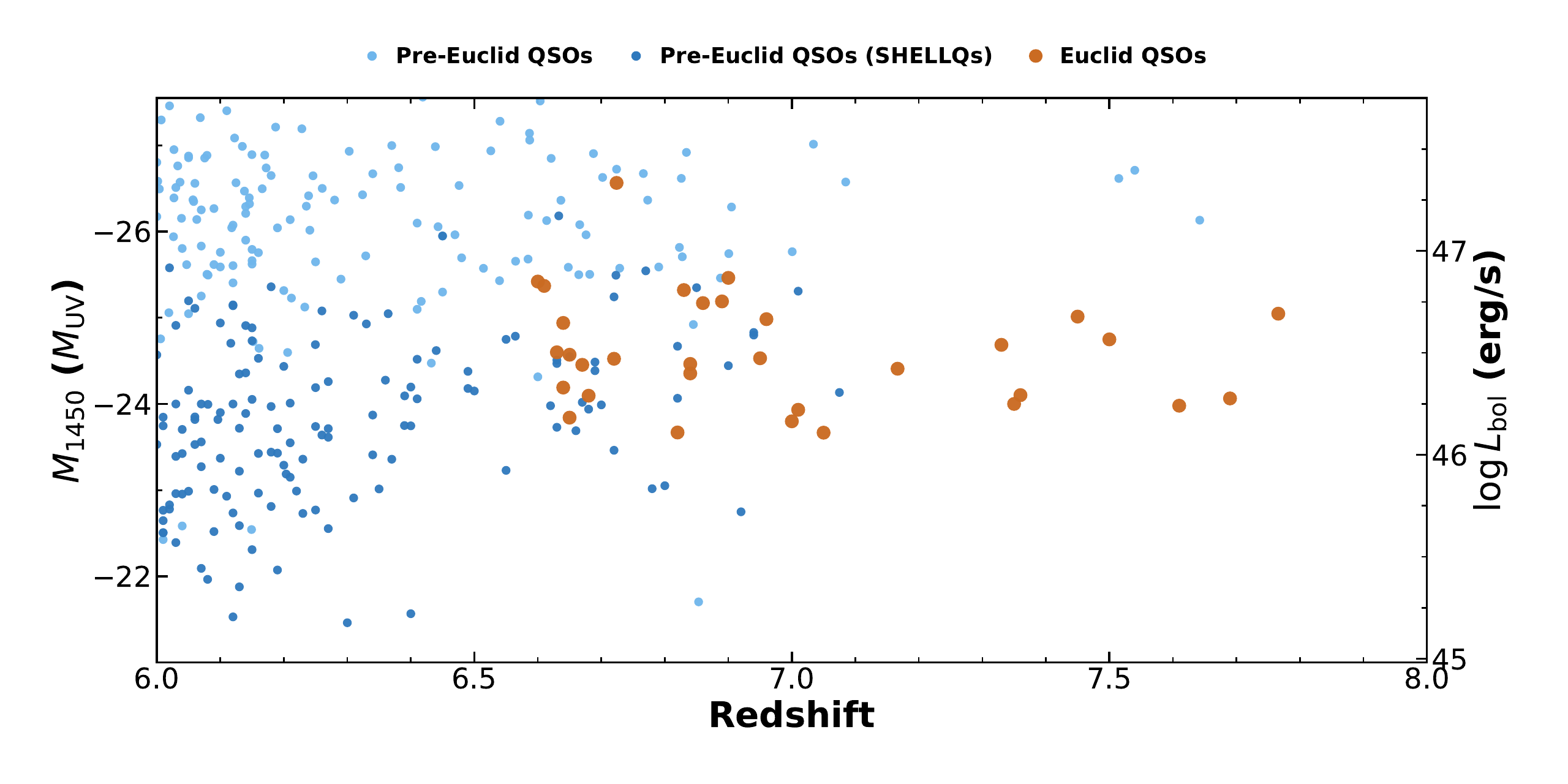
Euclid quasars in orange extend the known quasar population to higher redshifts and fainter ultraviolet luminosities.

UV-brightest galaxies during reionization

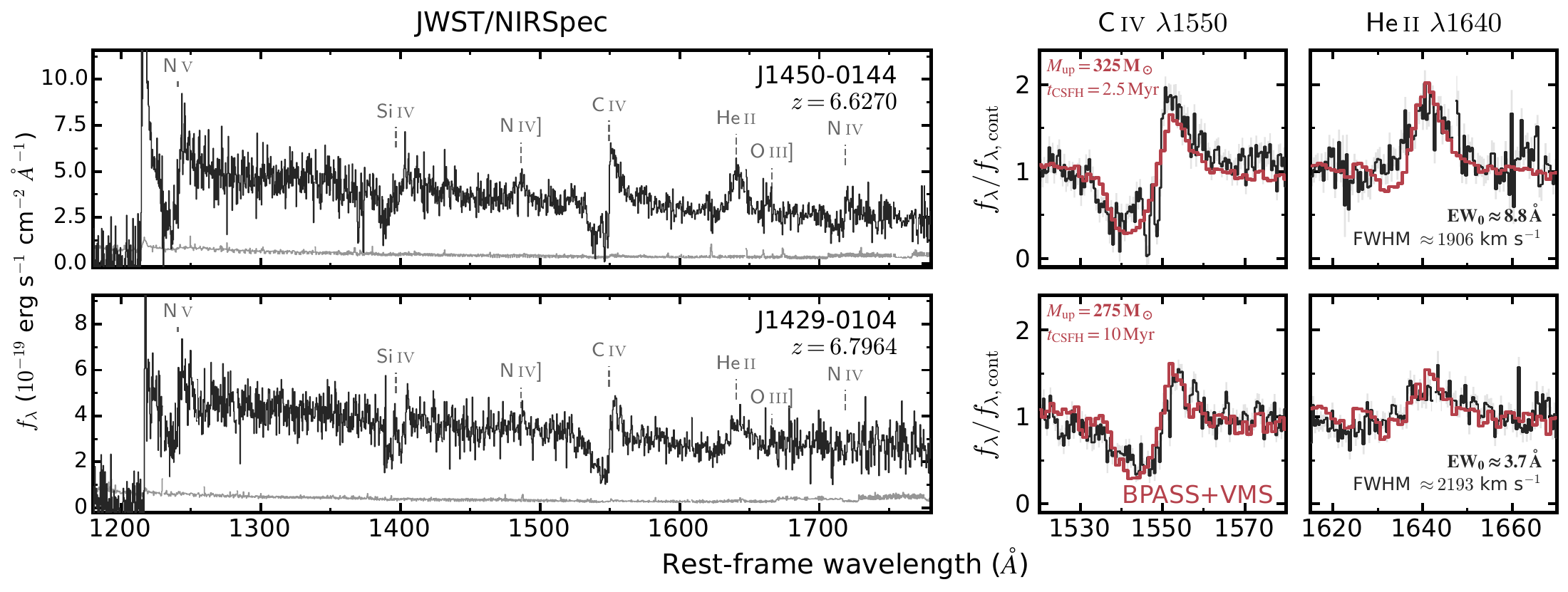
What makes some galaxies in the early Universe so bright in the ultraviolet? Our JWST observations revealed strong stellar-wind features in two sources previously classified as quasars, identifying them as intensely star-forming galaxies whose spectra favor models including very massive stars. These systems let us test how extreme stellar populations shape the light of the brightest galaxies during reionization, and reconsider where galaxies end and quasars begin in our surveys.

JWST spectra of J1450−0144 and J1429−0104, with close-ups of C IV and He II compared with models including very massive stars.

Supermassive black holes at z > 7

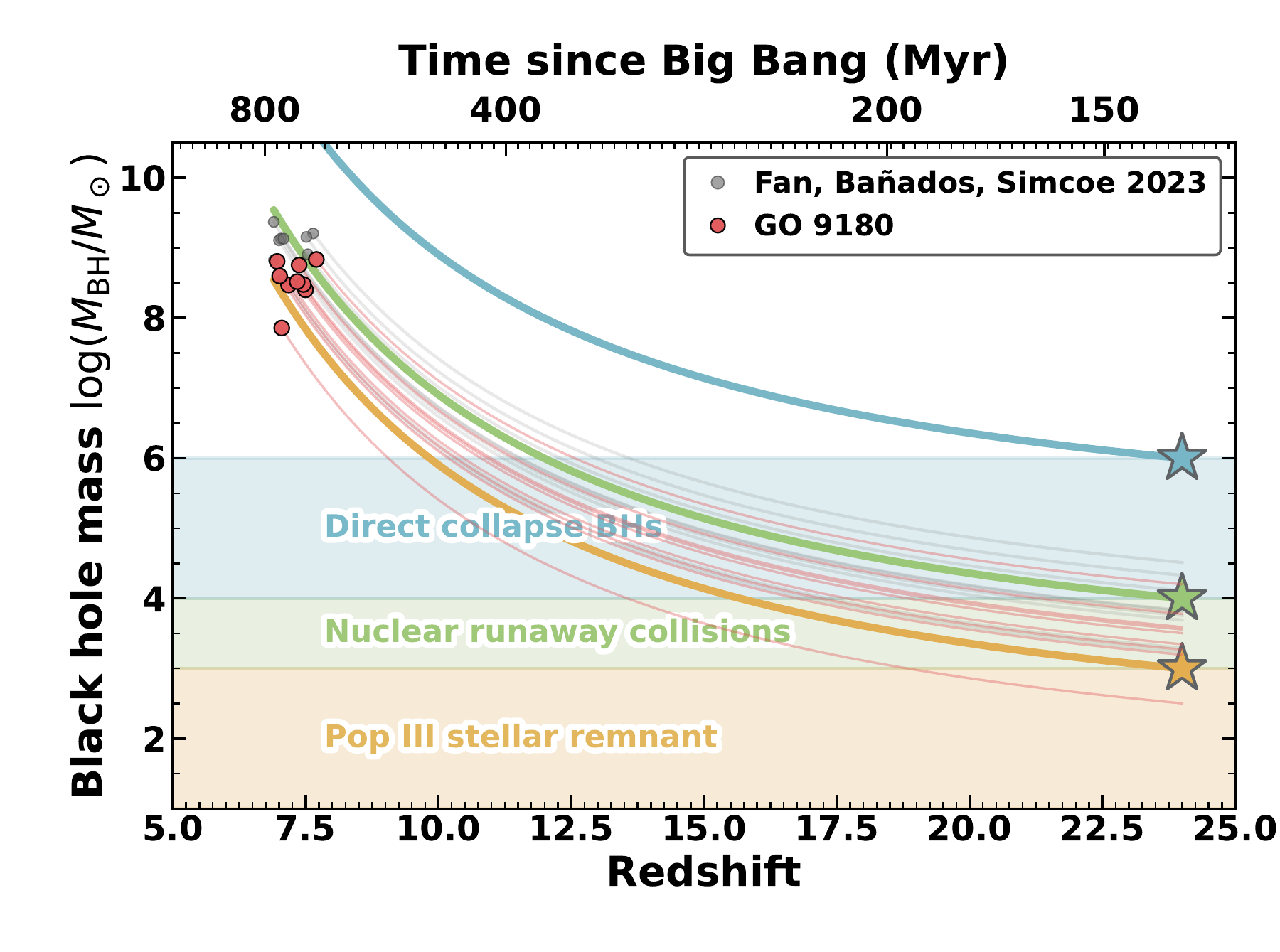
How did supermassive black holes assemble within the first billion years of cosmic history? I use JWST spectroscopy to measure black hole masses and accretion rates in distant quasars, extending these measurements to the fainter population uncovered by Euclid. Comparing their masses with possible growth histories helps test the seeds they could have formed from and how rapidly they must have gained mass in the early Universe.

Black hole masses versus redshift, with illustrative growth tracks connecting observed quasars to different black hole seed scenarios.

2021–2023

Master projects

My master's research explored how we identify distant quasars and what the galaxies hosting stellar tidal disruptions can tell us about these events. I built an archive of 176 quasar candidates observed with Keck and studied the stellar populations of tidal disruption event hosts. These projects connect careful source classification and galaxy measurements to better observing strategies and a clearer picture of black holes and their environments.